
We are strangely obsessed with faces.
We turn photographs over hoping somebody has written a name on the back. We zoom in. We study expressions. We look for resemblance.
We seem to believe that if we can see a person’s face, we might somehow know them.
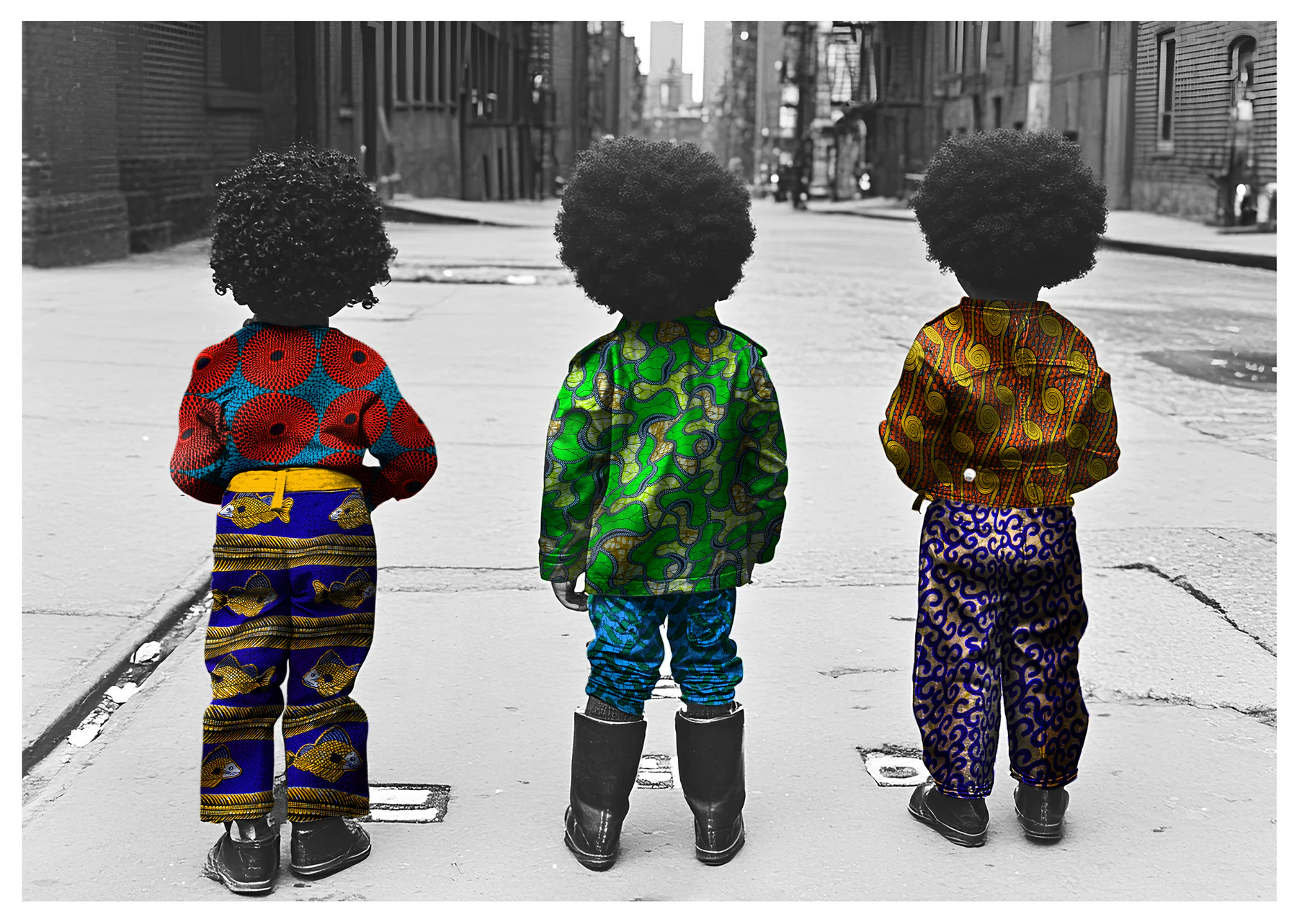
Which is why I love the fact that, in this picture, the boys are facing the wrong way.
Or perhaps the right way.
They aren’t looking at us.
They are looking at whatever comes next.
And suddenly the most interesting thing in the portrait isn’t identity.
It is direction.
There are three small figures standing at the edge of a street.
Ahead of them is somewhere I cannot see.
Behind them is me.
That arrangement feels important.
Because childhood is one of the few periods of life in which so much exists in front of you and so little has yet hardened into certainty.
You don’t know the job you’ll have.
The person you’ll love.
The city you’ll leave.
The city you’ll return to.
The thing you’ll unexpectedly become brilliant at.
The friendship that will save you one year.
The mistake that will redirect everything.
The ordinary Tuesday that, much later, turns out to have been a beginning.
All of it is somewhere further down the road.
Invisible.
Waiting.
Perhaps that is why adults become so sentimental about childhood.
Children possess something we cannot buy back once we understand its value.
An enormous amount of unwritten future.
The strange luxury of not knowing yet
When you are young, people continually ask what you are going to be.
It is an extraordinary question when you think about it.
As though a human life will eventually resolve itself into a noun.
Doctor.
Teacher.
Artist.
Engineer.
Parent.
Entrepreneur.
Something reassuring enough to write neatly inside a box.
But one of the great surprises of becoming an adult is discovering how badly those nouns describe a life.
You become things nobody asked about.
The friend who picks up.
The person who starts again.
The one who knows how to make everybody laugh when the room has become unbearable.
The keeper of a particular family story.
The person a child feels safe beside.
The person who finally says no.
The person who finally says yes.
We spend so much of childhood being asked what we will become, when perhaps the more beautiful question is:
What will you notice?
What will move you?
What will you protect?
What will you refuse to accept simply because everybody else has learned to?
What will make you lose track of time?
What will you carry forward?
I think those questions leave more room for a life.
There is something else I notice
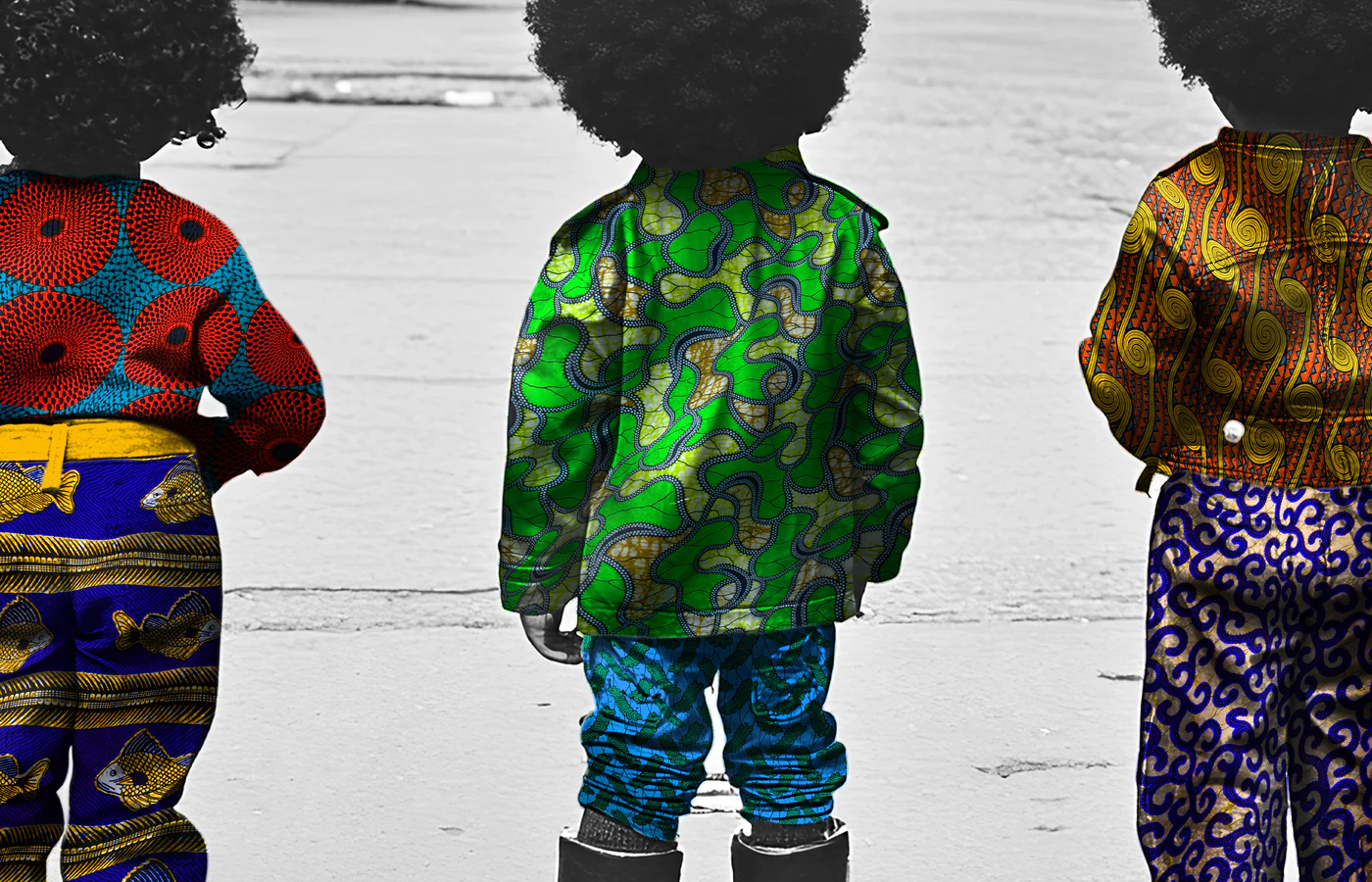
In my version of the image, the boys are facing away from me, but their clothes are full of pattern.
Their backs are visually louder than the street ahead.
I hadn’t consciously set out to make a philosophical point when I began working on the piece.
That isn’t usually how the work happens.
I respond visually first.
Pattern beside pattern.
Colour against monochrome.
Something ordinary made slightly impossible.
But afterwards, I noticed the contradiction.
They are moving visually towards the future while carrying something elaborate on their backs.
And I liked it enormously.
Because perhaps that is a useful way to think about inheritance.
Not as something that keeps us looking backwards.
As something we carry while facing forwards.
There is a difference.
Heritage can become a museum in our minds if we aren’t careful.
Something precious behind glass.
Something we visit respectfully and then leave exactly where it was.
But inheritance is more unruly than that.
It travels.
It mutates.
It gets misunderstood and rediscovered.
Recipes change because an ingredient wasn’t available.
Names alter as families move.
Music meets other music.
Stories are remembered differently by two people who were standing in the same room.
A phrase a grandmother used appears unexpectedly in the mouth of a great-grandchild who never met her.
Nothing living remains entirely still.
Perhaps culture doesn’t survive because we preserve it perfectly.
Perhaps it survives because somebody takes it somewhere.
What are we actually giving children?
When adults talk about giving children a good future, we usually mean practical things.
Safety.
Education.
Opportunity.
Money if we can.
A room of their own.
The right postcode if we’re fortunate enough to choose one.
Those things matter.
But I wonder about the invisible things too.
What does a child learn from what hangs on the walls?
From who appears important in the books?
From which faces are framed?
From whether beauty seems to include them?
From whether the people who resemble them are always being discussed in relation to hardship, or whether they are also allowed colour, humour, imagination, tenderness and possibility?
I don’t think a picture can tell a child who to become.
I wouldn’t want it to.
But perhaps pictures can enlarge the landscape of what feels imaginable.
That matters to me.
I can picture this artwork in a little boy’s bedroom.
Not because I want it to deliver some earnest motivational instruction every morning.
Quite the opposite.
I like that the boys aren’t performing ambition.
Nobody is standing on a podium.
Nobody is holding a trophy.
There is no obvious destination.
They are simply there.
Facing forwards.
The road exists.
That feels enough.
We underestimate how much children absorb before language catches up
A child may not be able to explain why an image makes him stand slightly taller.
He may never consciously think about the pattern.
He may barely acknowledge the picture after the first week.
It becomes part of the room.
Part of the visual weather of childhood.
The same way we remember a lampshade from our grandmother’s house, or the wallpaper behind the television, or the strange ornament nobody was allowed to touch.
Objects quietly enter us.
Years later, we discover they were helping to form our idea of what a home looked like.
What beauty looked like.
What adulthood looked like.
What we looked like.
That is one of the reasons I think art in children’s spaces deserves more thought than simply matching the bedding.
A child’s room is one of the first environments that belongs, however partially, to them.
It is a small kingdom.
A laboratory.
A spaceship.
A hiding place.
A library.
A stage.
A place where entire civilisations are constructed beneath a duvet after bedtime.
Why shouldn’t the art we put there contain possibility?
Adults need this picture too
The funny thing is that the longer I look at the three boys, the less convinced I am that this is really an artwork about childhood.
Perhaps it is about the part of adulthood we find hardest to retain.
The ability to face something without knowing exactly what it will become.
Adults like maps.
We like proof.
We want reviews.
Timelines.
Five-year plans.
We ask whether something is sensible before asking whether it is alive.
Eventually, possibility begins to frighten us because possibility contains no guarantee.
Children are much more familiar with not knowing.
Almost everything is new to them.
Perhaps that is why they can turn a cardboard box into six different things before lunch.
They haven’t yet become embarrassed by imagination.
There is a lesson in that.
Not a command to abandon responsibility and run dramatically into the unknown.
Just a reminder that certainty isn’t the only respectable way to move forward.
Sometimes you can begin before you know the ending.
Sometimes you can make the thing before anybody understands why.
Sometimes the road reveals itself because you started walking.
Maybe that is what I want the boys to keep
Not innocence.
I’m suspicious of that word.
Children aren’t empty vessels floating around in some perfect state before adulthood ruins everything.
They are complicated people already.
What I want them to keep is something else.
The sense that the horizon belongs to them too.
The suspicion that there may be more than one route.
The confidence to turn a corner without requiring the entire journey to introduce itself first.
The knowledge that whatever they carry does not have to weigh them down.
It might be exactly what gives them somewhere to begin.
And perhaps that is why I am glad we cannot see their faces.
If they had turned around, the picture might have become about who they were.
Instead, it remains about where they might go.
There is a great deal of love in allowing somebody a future you cannot imagine for them.
Not choosing it.
Not narrowing it.
Not asking it to resemble yours.
Just giving them something beautiful to carry and enough room to move.
Then standing behind them, for as long as you are needed.
And eventually letting them disappear around the corner.
Give possibility a place in the room
Some artworks tell a child what to think. I prefer the ones that leave the door open.
Discover this piece and other Frequency of Love artworks created to bring colour, identity and imagination into the spaces we live in.