
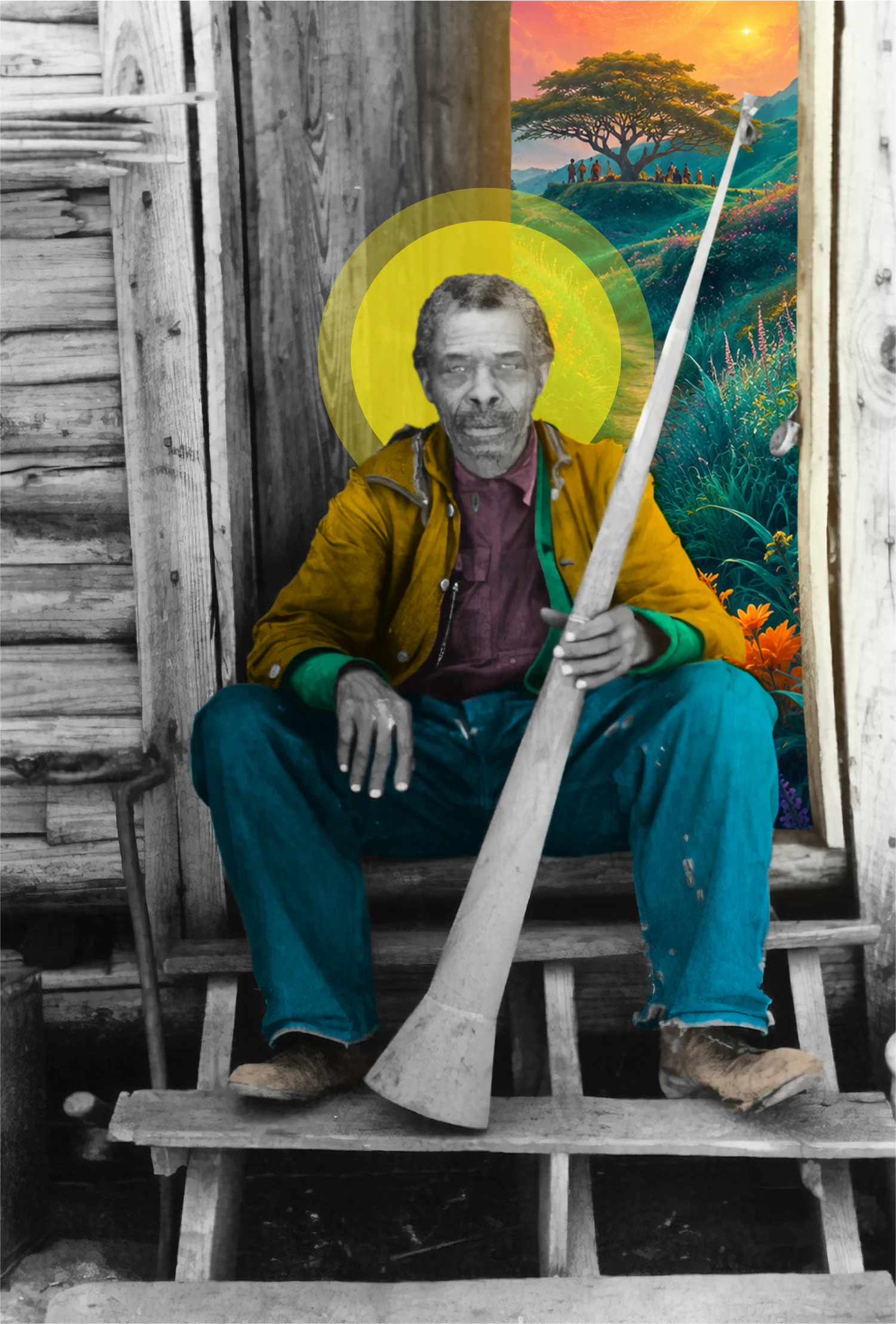
At first, I thought the most important thing in this photograph was the horn.
I was wrong.
The most important thing might be the fact that it no longer works.
Not physically.
I imagine, although I don’t know, that somebody could probably still make a sound through it.
I mean the other kind of working.
The kind that required a sound to become an instruction.
A horn is only a hollow object.
Air goes in.
Sound comes out.
Everything else has to be invented around it.
Someone has to decide that the sound means come.
Or go.
Or begin.
Or stop.
And, more importantly, somebody else has to live inside circumstances in which refusing that sound is not genuinely available to them.
That is where the power is.
Not in the horn.
In the world constructed around it.
His name was Willis Winn
The photograph was made near Marshall, Texas, in April 1939 by photographer Russell Lee. The Library of Congress catalogue identifies the sitter as Willis Winn, a formerly enslaved man, and describes the object in his hands as the horn “with which slaves were called”.
There is also an earlier Library of Congress photograph from 1937 showing Winn outside a log cabin beside what the catalogue calls a slave horn. That image forms part of the WPA Federal Writers’ Project collections relating to formerly enslaved African Americans.
His recorded narrative contains a memory of a horn being blown to signal the end of work.
There are many directions one could travel from there.
The history is enormous.
But something much smaller keeps holding my attention.
His hands.
Because by 1939 the horn is no longer instructing the man.
The man is holding the horn.
And that reversal is almost unbearably quiet.
Objects are very good at pretending to be innocent
We surround ourselves with objects whose meaning seems obvious because we have inherited the rules attached to them.
A crown is metal and stones.
A banknote is paper.
A flag is fabric.
A uniform is clothing.
A wedding ring is a small circle of metal.
A key is an oddly shaped piece of something hard.
None of these objects contains its social meaning naturally.
We put the meaning there.
Then, eventually, we forget that we did.
That is the peculiar magic of symbols.
A piece of paper becomes valuable because millions of people agree that it represents value.
A uniform can cause somebody to straighten their posture.
A door can become forbidden because of the sign attached to it.
A sound can make people move.
The object begins to look powerful.
But objects are rarely powerful by themselves.
They are carrying an agreement.
Or a threat.
Or a law.
Or a hierarchy.
Or a memory.
Sometimes all of them at once.
That changes the way I see the horn.
It is not merely an old instrument.
It is an object that once belonged to a system of command.
And in Willis Winn’s hands, that command has become evidence.
There is something strange about surviving the thing that once controlled you
We talk a lot about survival.
Usually in terms of people.
Less often in terms of objects.
But objects survive too.
Buildings outlive governments.
Furniture outlives marriages.
Clothes outlive bodies.
Documents outlive the people whose lives they altered.
A key may survive the lock.
A weapon may survive the war.
A sign may survive the law that required it.
And suddenly an object designed for one world finds itself stranded in another.
Its function becomes history.
That is what fascinates me here.
The horn once meant something immediate.
Its sound had consequence.
By the time it was photographed in Winn’s hands, it had become something else.
A relic.
A witness.
Evidence that a particular arrangement of power had existed.
The object survived.
But its authority did not.
There is something deeply satisfying in that distinction.
Not because history resolved itself neatly. It didn’t.
The end of legal slavery in the United States did not produce the end of racism, violence, exploitation or inequality.
But this particular object’s transformation still matters.
Something that once participated in command can eventually become incapable of commanding.
Power can expire before matter does.
Perhaps power is more fragile than it looks
That thought has stayed with me.
Systems of power work very hard to appear permanent.
They build grand buildings.
Write laws.
Create ceremonies.
Design uniforms.
Invent titles.
Produce paperwork.
Put important people on raised platforms.
They make themselves look like the natural order of things.
Of course this is how the world works.
Of course this person commands and that person obeys.
Of course this door is for them and that door is for you.
Of course it has always been this way.
And then history does what history does.
The unquestionable becomes questioned.
The permanent becomes dated.
The rule becomes an embarrassment.
The sign comes down.
The uniform goes into a museum.
The horn becomes something an old man holds while a photographer takes his picture.
I find that profoundly hopeful.
Not comfortably hopeful.
Not the sort of hope that pretends terrible things automatically improve with time.
They don’t.
People change them.
But history is full of structures that once presented themselves as inevitable and were not.
That means inevitability should always make us a little suspicious.
I wonder how many things around us are pretending to be inevitable now
This is where historical photographs become dangerous in the best possible way.
If we look at them only as pictures of what used to be, we can keep ourselves very comfortable.
Look at the strange clothes.
Look at the old building.
Look how terrible people were then.
How fortunate that we are standing over here in the enlightened present.
But history is more useful when it turns around.
When it asks something back.
What do we currently treat as natural simply because it is familiar?
Which hierarchy have we mistaken for reality?
Which rule has existed for so long that we have stopped asking who benefits from it?
Which object, phrase, institution or custom will look astonishingly revealing in a photograph eighty years from now?
I don’t know.
That’s what makes the question worth asking.
Every generation is excellent at spotting the absurd assumptions of the generations before it.
We are considerably less talented at seeing our own.
The camera changes things too
There is another layer to this photograph.
Winn is not simply holding the object.
We are looking at him holding it.
That matters.
Photography can turn a tool into testimony.
Something ordinary enough to exist in a working environment becomes, through survival and documentation, an artefact.
The camera says:
Look.
This existed.
This person existed.
These two things occupied the same frame.
But photography is never the whole story.
A photograph can preserve evidence while stripping away context.
It can turn a complicated human being into “the man with the horn”.
That troubles me.
Because Willis Winn was a person before he became a historical subject.
He cannot be reduced to slavery simply because slavery is the reason his photograph entered an archive.
This is something I think about often when working with historical images of Black people.
The archive can preserve people and flatten them at the same time.
A person becomes:
slave.
servant.
worker.
protester.
soldier.
mother.
migrant.
The category survives more efficiently than the life.
But nobody wakes up in the morning experiencing themselves as an archive category.
People experience hunger.
Boredom.
Vanity.
Affection.
Irritation.
Humour.
Fatigue.
Desire.
The millions of small sensations that make up a day.
History needs categories.
Human beings exceed them.
Perhaps colour is one way I resist the flattening
When I work with an image like this, I am conscious that the original photograph already carries enormous historical weight.
It does not need me to make it more dramatic.
I am not trying to make slavery beautiful.
I am not trying to soften history.
And I am certainly not trying to decorate suffering.
The colour has another job.
It interrupts the distance.
Historical black-and-white photography can accidentally make the past feel as though it occurred in another substance.
As if people once lived in monochrome.
Of course they didn’t.
Their world was as visually immediate to them as ours is to us.
So when pattern and colour enter my work, they don’t claim to reproduce what was originally there.
They create a contemporary encounter with what remains.
For me, that distinction matters enormously.
The colour says:
Do not file this person away.
Look again.
Stay for another second.
Notice the posture.
Notice the hands.
Notice the object.
Then ask why it is there.
The loudness of the artwork can create a route into something very quiet.
And still I return to his hands
Because the horn looks different once it is held.
Objects designed to control people acquire a peculiar vulnerability when those people survive them.
The horn cannot explain itself.
It cannot defend the system in which it functioned.
It cannot command the photograph.
It simply sits there.
Held.
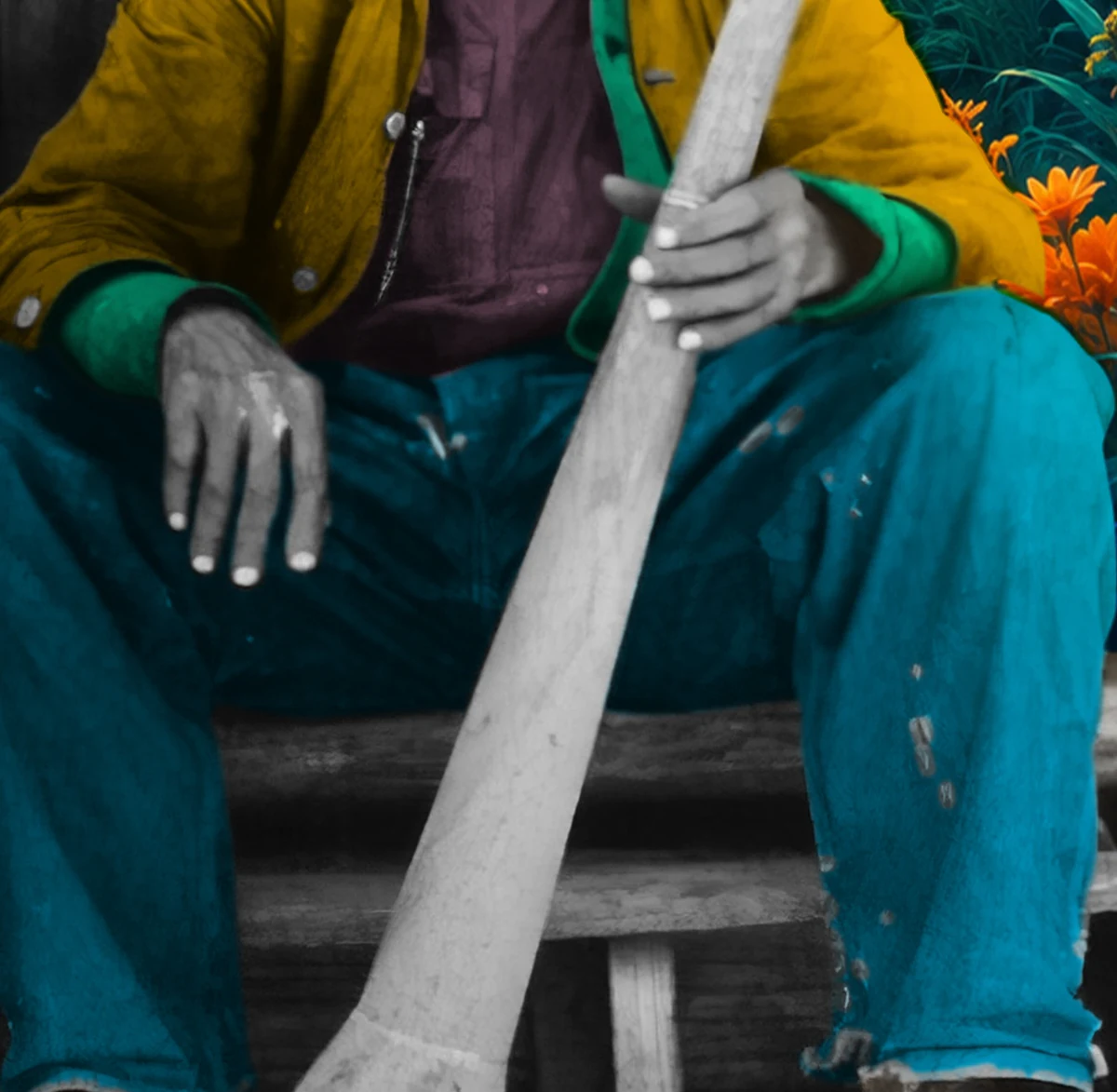
I find the physicality of that extraordinary.
His hands have become the frame around the object.
Not the other way around.
Perhaps this is why historical artefacts can affect us so differently from historical facts.
A date tells us something happened.
An object makes us confront the fact that it happened in the physical world.
Somebody touched this.
Somebody heard this.
Somebody built this.
Somebody carried this.
The abstract becomes material.
And once something becomes material, it becomes harder to tuck neatly inside the word history.
There are sounds that disappear and sounds that remain
We have no sound recording of this photograph.
The image is silent.
That silence feels significant.
The horn is right there.
Its entire reason for existing was sound.
Yet the photograph gives us none.
Perhaps imagination supplies it.
Perhaps it shouldn’t.
Sometimes silence is more powerful.
Because what the photograph gives us instead is the aftermath.
The sound has already happened.
The commands have already been given.
The days of forced labour to which such horns belonged have already passed.
And Willis Winn is still here.
Holding the thing.
There is dignity in that which I don’t want to embellish.
The picture doesn’t need a triumphant ending invented for it.
Survival is complicated.
Memory is complicated.
History is complicated.
But there is one thing I think the photograph allows us to say.
The horn outlived its command.
The man outlived the system that had enslaved him.
Those are not the same kind of survival.
But placing them together makes me think differently about power.
We should pay attention to things that only work because everybody believes they do
That may be what I carry away from the photograph.
Not simply an image of slavery.
A warning about power.
Power likes to hide inside objects.
Titles.
Rules.
Traditions.
Institutions.
Doors.
Desks.
Clothes.
Money.
Technology.
It attaches itself to something visible so completely that eventually we mistake the container for the thing itself.
But sometimes history separates them for us.
The crown sits behind glass.
The sign is taken down.
The document becomes an exhibit.
The horn goes quiet.
And we discover that what looked permanent was actually dependent on millions of repeated acts of recognition, coercion or obedience.
That does not make power unreal.
Quite the opposite.
But it does mean power can change.
It can move.
It can be refused.
It can be dismantled.
It can lose its language.
An object that once said you must can become an object that says this happened.
That transformation matters.
Perhaps that is one reason I make these pieces
Not to rescue the past.
The past does not need rescuing by me.
Not to improve an archive.
And not to turn every historical photograph into an uplifting story.
Some things should remain uncomfortable.
But I do want to interrupt the speed with which we look.
Because looking quickly is dangerous.
Quickly, this is an old man holding a strange object.
Look longer and the object acquires history.
Look longer still and its silence begins to feel as significant as its former sound.
And then perhaps the photograph stops being solely about Willis Winn.
It starts asking us about every system that currently sounds so loud we cannot imagine it ever falling silent.
History has heard loud things before.
Some of them seemed permanent.
Now they sit behind glass.
Or in archives.
Or silently in somebody’s hands.
Live with art that keeps revealing itself
Frequency of Love historical works begin with images worth looking at twice. Through colour, pattern and collage, they become contemporary pieces that hold history without leaving it safely in the past.