
Nobody is born worrying that they are a bit much.
That comes later.
Later, we learn about volume.
Appropriate behaviour.
Good manners.
Not showing off.
Not making a fuss.
Not speaking unless we are sure.
Not wearing the thing if it attracts too much attention.
Not asking the question if everybody else seems to understand.
Not taking ourselves too seriously.
Not assuming anybody wants to hear what we have to say.
Most of this education is so ordinary that we barely notice it happening.
A look across a room.
A laugh at the wrong moment.
A sentence beginning, “Don’t you think that’s a bit…”
A teacher who prefers one kind of confidence and finds another exhausting.
A workplace in which everybody says they want ideas until somebody actually has one.
A social rule nobody remembers agreeing to.
Eventually, many of us become very sophisticated at shrinking without appearing to move.
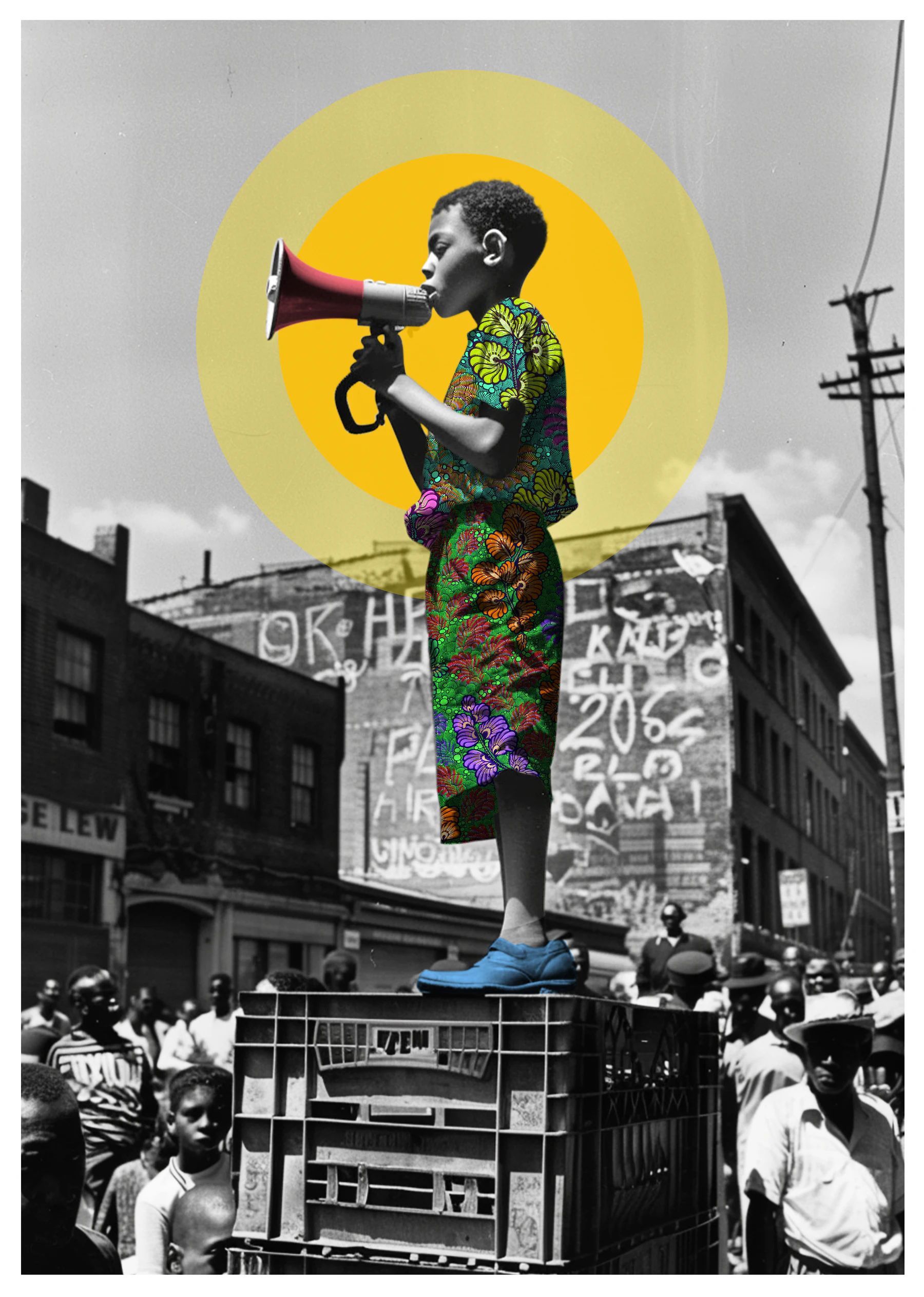
Which may be why I like this boy so much.
He is standing above everybody else with a megaphone.
Subtle he is not.
The crate might be the most important thing in the picture
The first thing that interested me about this image wasn’t actually the megaphone.
It was what he was standing on.
A stack of crates.
He isn’t naturally the tallest person in the scene.
Quite the opposite.
He is small.
So the picture solves the problem.
If the person isn’t tall enough, raise the platform.
If the voice isn’t loud enough, amplify it.
Simple.
And yet the longer I looked, the more profound that little arrangement began to feel.
Because adults become extraordinarily good at doing the reverse.
When something doesn’t quite accommodate us, we often adjust ourselves.
Speak more quietly.
Ask for less.
Wait longer.
Become more agreeable.
Make the ambition sound accidental.
Pretend the thing we want doesn’t matter terribly much, just in case wanting it openly makes somebody uncomfortable.
Sometimes that adjustment is wisdom.
Sometimes it is consideration.
And sometimes, if we’re being careful, it is simply disappearing in instalments.
The crate proposes another possibility.
Maybe you aren’t always the thing that needs adjusting. Maybe you need something to stand on.
At some point, confidence becomes suspicious
Children often begin with a fairly spectacular assumption that their thoughts are relevant.
They interrupt conversations to report sightings of unusual insects.
They show you drawings without first establishing whether the drawing is good.
They perform dances nobody requested.
They tell jokes with questionable narrative structure and absolute faith in the ending.
They ask questions in public that cause every adult nearby to become suddenly interested in the ceiling.
And they announce plans.
“I am going to be…”
Then something enormous.
A footballer.
An astronaut.
An inventor.
A chef.
A superhero.
A dinosaur.
Nobody has explained feasibility yet.
There is a kind of freedom in that.
Not because children are naturally fearless. Of course they aren’t.
But because self-consciousness has not always completed its architecture.
There is still, for a while, a gap between impulse and embarrassment.
Then adulthood arrives carrying measurements.
Talented enough.
Experienced enough.
Young enough.
Old enough.
Qualified enough.
Serious enough.
Connected enough.
Realistic enough.
The world develops a clipboard.
And eventually we become so familiar with its questions that nobody needs to ask them anymore.
We ask them ourselves.
Perhaps confidence has been misunderstood
We talk about confidence as though it is a substance some people possess in larger quantities.
He has confidence.
She lacks confidence.
Build your confidence.
Become more confident.
But perhaps confidence is sometimes less about believing you are extraordinary and more about forgetting to make yourself irrelevant.
The boy with the megaphone doesn’t need to believe he is the most important person in the world.
He simply needs to believe that speaking is available to him.
That distinction interests me.
Because the instruction to “be confident” can become another exhausting performance.
Stand straighter.
Speak louder.
Believe in yourself.
Project.
Perform.
Turn yourself into somebody impressive.
What if confidence begins somewhere much quieter?
With:
I am allowed to be here.
I am allowed to have an opinion before it is perfect.
I am allowed to ask.
I am allowed to change my mind.
I am allowed to take the opportunity seriously.
I am allowed to wear the extraordinary coat.
I am allowed to be a beginner in public.
I am allowed to make work people may not understand immediately.
I am allowed to take up the amount of space the thing requires.
That feels much more useful to me than simply learning how to be loud.
Which is ironic, given the megaphone
The artwork began with an AI-generated image.
There was no real demonstration.
No historical speech.
No political movement for me to explain.
No young activist whose story I could legitimately attach to the picture.
And I rather like the freedom that gives the work.
Because the boy can remain something broader.
The megaphone becomes amplification itself.
The picture asks a question rather than documenting an answer:
How audible do we believe we are allowed to be?
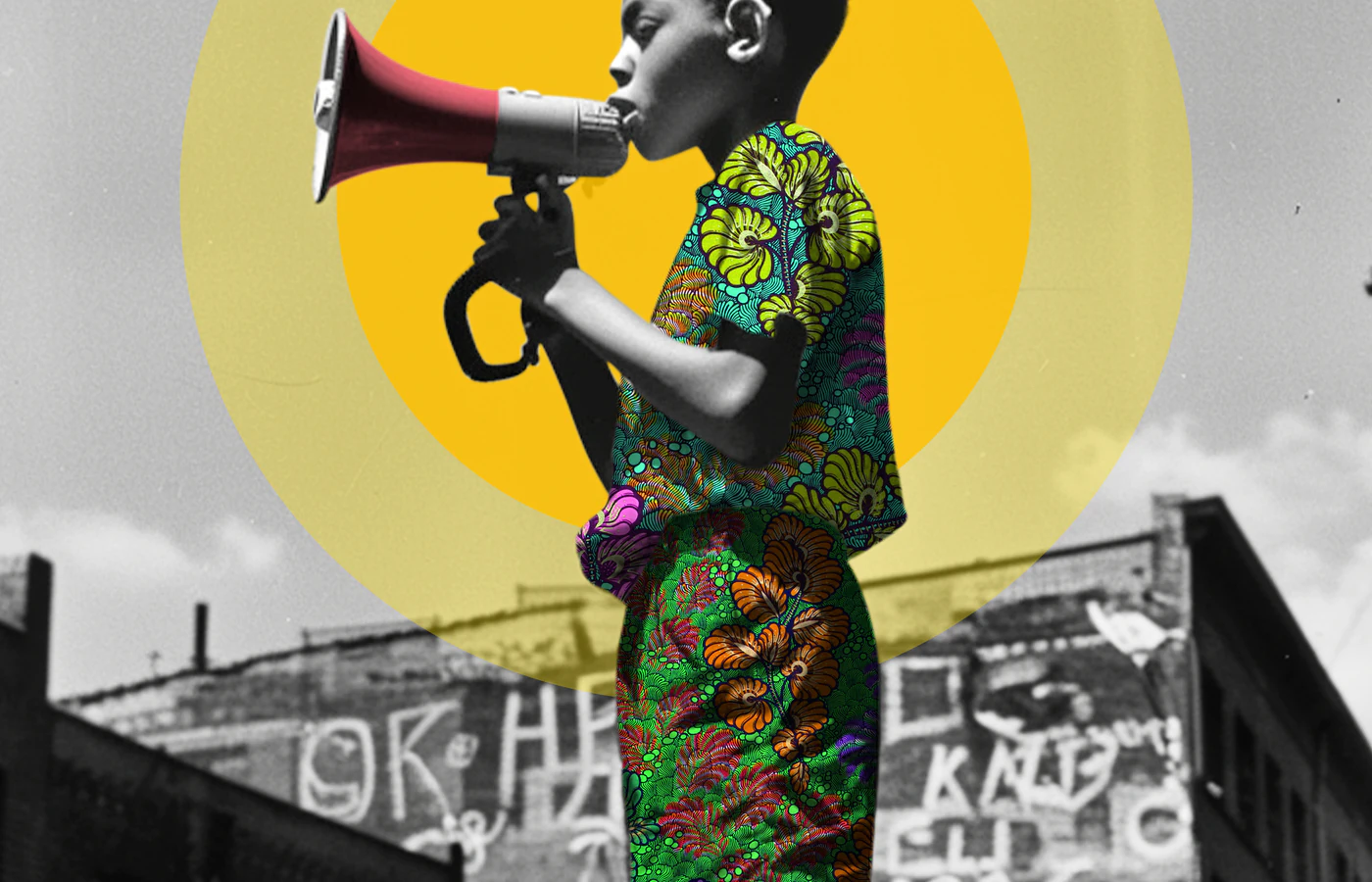
When I began working into the image, I did what I often do instinctively, following the visual language of Frequency of Love.
Colour arrived.
Pattern arrived.
The megaphone changed.
His clothes became impossible to ignore.
Circles formed behind him.
The monochrome world stayed relatively quiet while he became visually louder.
I wasn’t consciously constructing an argument about power.
I was making the image feel right.
But afterwards I noticed what had happened.
The smallest person in the picture had become the most difficult person to overlook.
I love that.
Small is not the same as insignificant
Those two things get confused surprisingly often.
We do it literally with children.
Adults speak over them.
Speak for them.
Assume they haven’t noticed.
Continue a conversation because they “won’t understand”.
Then, six months later, a child repeats one devastatingly accurate sentence and everybody discovers that he was apparently conducting field research the entire time.
There is something wonderful about the seriousness with which children observe adults.
They notice hypocrisy with particular efficiency.
They notice which rules suddenly change when grown-ups are inconvenienced by them.
They notice who gets listened to.
Who gets interrupted.
Who everyone becomes careful around.
Who is allowed to be angry.
Who is expected to be pleasant.
They may not have the vocabulary for the structure.
They can still see it.
Which makes the old expression about wisdom coming from the mouths of children rather interesting.
We tend to imagine that children occasionally say profound things by accident.
Perhaps sometimes they simply haven’t learned to disguise the obvious yet.
That is where the original title came from
I had been thinking of this work as From the Mouth of Babes.
The phrase suited the visual idea: a child speaking while adults gather below.
But the more I sat with the artwork, the more I realised that what interests me isn’t really the surprising wisdom of children.
It is the assumption behind the surprise.
Why are we surprised when a small person says something worth hearing?
Why should size determine significance?
Why should age automatically establish whose observation matters?
And why, as adults, do so many of us eventually internalise a similar hierarchy and begin treating our own voices as though they need permission?
The artwork started asking a bigger question than its original title.
That is why the finished work is called No Need to Whisper.
Representation isn’t only about who appears
We often talk about representation as the experience of seeing somebody who looks like you.
That matters enormously.
But I think there is another question hiding underneath it.
What are they allowed to be doing when you see them?
Are they central or peripheral?
Are they being acted upon or deciding?
Are they always struggling?
Are they always noble?
Are they allowed to be ridiculous?
Inventive?
Quiet?
Joyful?
Powerful?
Tender?
Uncertain?
Are they allowed imagination?
Are they allowed authority?
Are they allowed to occupy a picture without first proving why they deserve to be there?
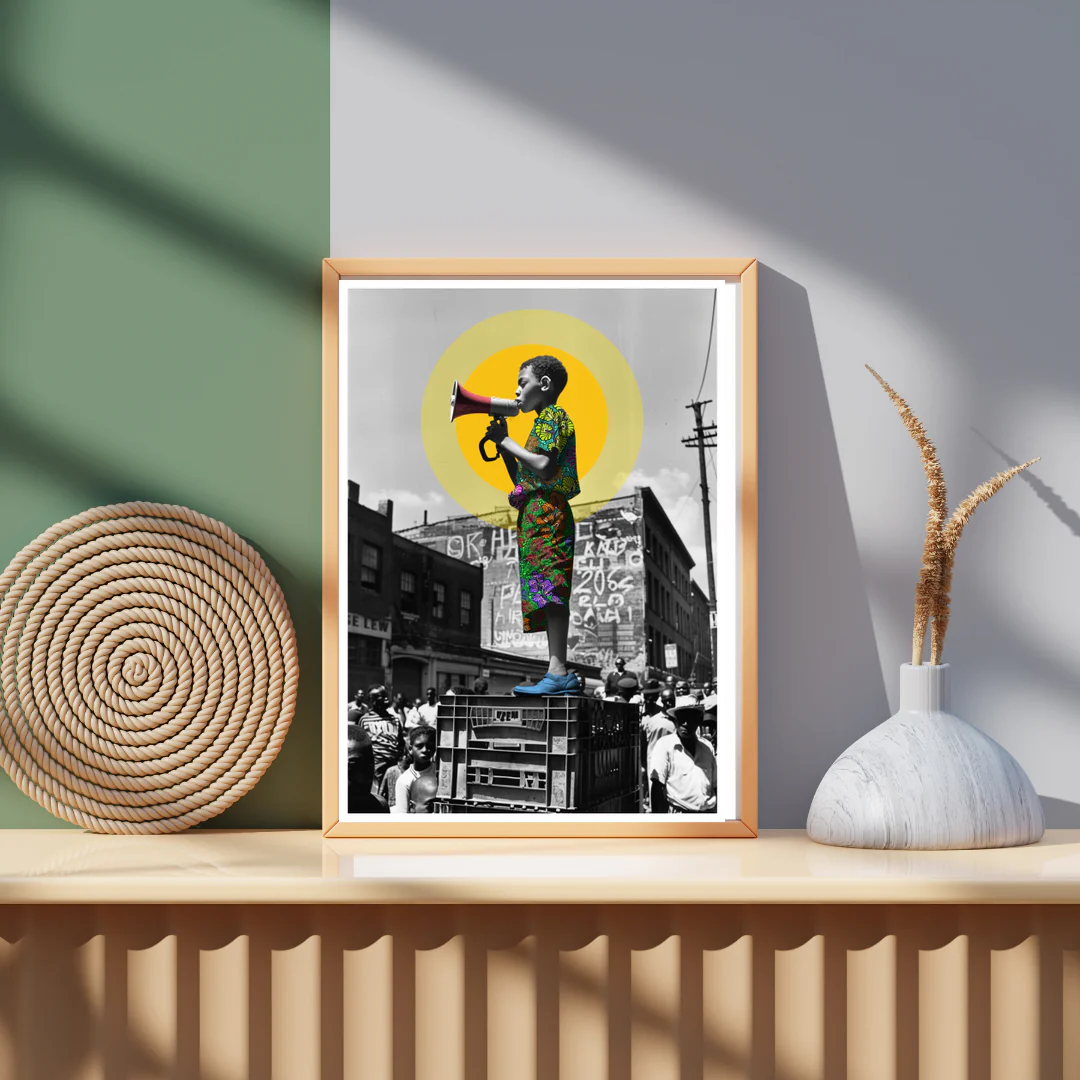
I think about that when I imagine this work hanging in a boy’s room.
I don’t particularly want a child to wake every morning, look at it and think:
Today I must be powerful.
What an exhausting way to start breakfast.
I’d rather something quieter happen.
Perhaps nothing consciously happens at all.
There is simply a boy on the wall.
He is central.
He has the device everybody listens to.
He is wearing extraordinary colour.
He is elevated.
Nobody has moved him politely to the edge of the composition.
That visual possibility becomes ordinary.
And ordinary is powerful.
Rooms teach us things
I’ve started thinking more and more about this.
Rooms are not neutral.
Especially the rooms we grow up in.
The objects around us conduct tiny lessons all day without ever announcing a curriculum.
Who appears in pictures.
Who looks important.
What beauty looks like.
What adulthood looks like.
Who gets framed.
Who gets colour.
Who gets softness.
Who gets seriousness.
Who gets to be enormous.
Who is decorative.
Who is absent.
Of course, no seven-year-old sits on the end of his bed conducting a semiotic analysis of the artwork.
Thankfully.
He is much more likely to be looking for a missing sock.
But we absorb environments long before we explain them.
Think of the things you remember from childhood homes.
A wallpaper pattern.
The picture above somebody’s fireplace.
A lampshade.
The ornaments you weren’t allowed to touch.
The mysterious cupboard containing things adults apparently considered important.
Those objects became part of your definition of home without asking permission.
Why wouldn’t art do the same?
This is one reason I think artwork in children’s rooms can be much more interesting than something chosen simply because it matches the curtains.
A child’s room is one of their first pieces of territory.
A small kingdom.
A laboratory.
A football stadium.
A spaceship.
A hiding place.
A library.
A stage.
A place where cardboard becomes infrastructure and a duvet becomes architecture.
There should be room on those walls for imagination too.
Read more about what children’s environments quietly make possible in The Future Is Usually Photographed From Behind.
Boys receive particular instructions about volume
This is something I think the image allows us to consider carefully.
Boys can receive contradictory messages about their voices.
Be bold.
Be strong.
Speak up.
Don’t be weak.
But also:
Don’t be difficult.
Don’t be disruptive.
Don’t be threatening.
Don’t be too emotional.
Don’t say you are frightened.
Don’t admit you don’t know.
Don’t cry.
Don’t care too visibly.
The acceptable version of confidence can become surprisingly narrow.
And that matters because having a voice isn’t only the ability to speak loudly.
Sometimes having a voice means being able to say:
I don’t understand.
I need help.
That hurt.
I was wrong.
I love this.
I don’t want that.
I’m frightened.
I changed my mind.
Listen to me.
Listen to him.
The most powerful voice in the room isn’t always the loudest one.
Sometimes it is the person secure enough to say what is true.
That is a much more interesting kind of strength.
Adults have rooms too
This is where the essay inconveniently stops being about children.
Because adults are surrounded by visual instructions as well.
We just pretend we are sophisticated enough not to notice.
We scroll.
We compare.
We enter offices.
Walk through shops.
Visit other people’s homes.
See advertisements.
Watch programmes.
Look at bodies.
Look at success.
Look at taste.
We absorb thousands of tiny suggestions about what a convincing life is supposed to resemble.
And then we go home.
That part interests me.
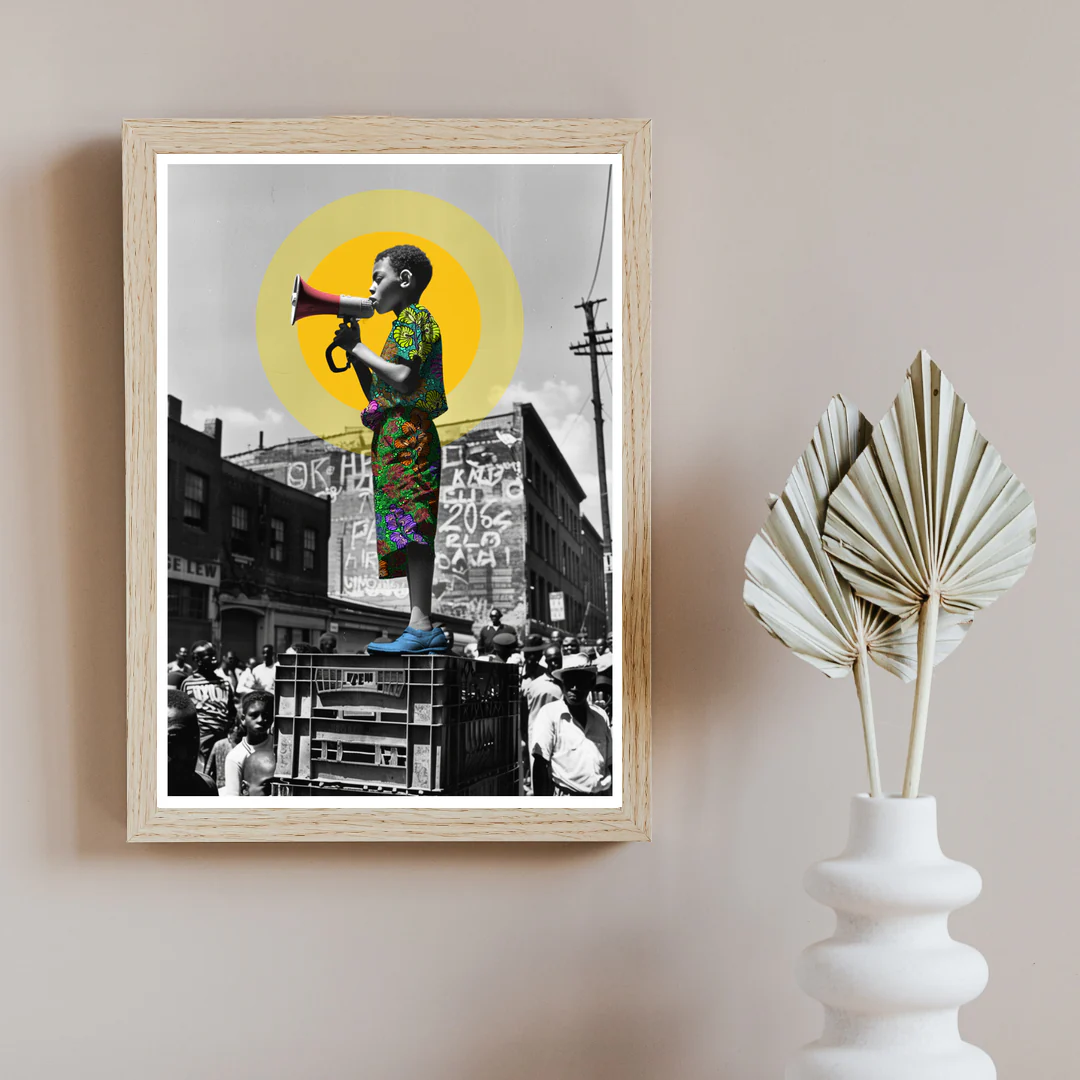
Because the art we choose for our homes is one of the few opportunities we have to decide what gets repeated in front of us.
The reason can be entirely aesthetic.
I love that orange.
That pattern makes me happy.
I need something huge on that wall.
All excellent reasons.
But sometimes an artwork stays because it behaves differently from the rest of the world.
It carries a certain irreverence.
A certain beauty.
A certain scale.
A particular refusal to become background.
And after walking past it for years, perhaps we borrow a little of its behaviour.
There is an age at which showing off becomes embarrassing
I don’t know precisely when it happens.
But almost everyone remembers some version of the transition.
At first:
Look at me.
Look what I made.
Watch this.
Listen.
Come and see.
Then suddenly wanting to be seen becomes risky.
Enthusiasm can be uncool.
The teenager develops defences.
The adult perfects modesty.
“I just threw this together.”
“It was nothing.”
“I’m probably being stupid.”
“This might be a terrible idea.”
“Sorry, can I just say something?”
Sorry.
That little word gets everywhere.
Sometimes appropriately.
Sometimes bizarrely.
Sorry for the email.
Sorry for asking.
Sorry for taking a minute.
Sorry for speaking at the same time.
Sorry for wanting.
Sorry for taking up six inches of additional atmosphere.
Perhaps the boy with the megaphone appeals to me because there is no visible preface.
No apology before the sentence.
Just amplification.
Of course, taking up space is not the same as taking space from somebody else
This distinction matters.
The answer cannot be a world full of people screaming through megaphones because nobody ever informed them that other human beings also exist.
We have enough evidence that certainty without curiosity isn’t particularly attractive.
Confidence without humility becomes arrogance.
Voice without listening becomes noise.
Power without consideration becomes something uglier.
Perhaps the real lesson isn’t:
Never make yourself smaller.
It is:
Don’t confuse making room for somebody else with disappearing yourself.
You can listen without erasing yourself.
You can move aside without believing you belong at the edge.
You can admit uncertainty without treating uncertainty as proof that your thoughts have no value.
You can celebrate another person’s brilliance without interpreting it as an accusation about your own.
You can be gentle without becoming invisible.
There is room for more than one person to matter.
That may be one of adulthood’s harder lessons.
I wonder what we would make if embarrassment arrived later
That thought follows me around.
What would you have painted?
What would you have written?
What business would you have started?
What colour would you have worn?
Who would you have spoken to?
What instrument would you have played badly for long enough to become good?
Where would you have gone?
What would you have danced to despite possessing absolutely no evidence of rhythm?
What would you have tried before becoming extremely sensible about the probability of failure?
There is no point romanticising every abandoned possibility.
Some ideas deserve to be abandoned.
Some hairstyles did too.
But caution occasionally disguises itself as maturity.
Sometimes “being realistic” is simply fear wearing sensible shoes.
And perhaps one of the difficult tasks of adulthood isn’t becoming fearless.
It is learning which fears deserve authority.
Maybe confidence isn’t something we need to find
Perhaps that is the final thing this boy has made me wonder.
What if some of what we call building confidence is actually unlearning unnecessary permission?
Not becoming someone new.
Remembering somebody old.
The child who raised his hand before calculating whether the answer would make him look foolish.
The child who wore the costume outside.
The child who built the impossible thing from cardboard.
The child who told you his idea before checking whether anybody else thought it impressive.
The child who assumed curiosity was reason enough to ask.
We cannot remain children.
Nor should we.
Experience gives us judgement.
Compassion.
Restraint.
Perspective.
The ability, ideally, to understand that everybody else’s story is happening too.
But growing wiser does not have to mean becoming smaller.
Perhaps we can keep the discernment and reclaim some of the audacity.
Know when to listen.
Know when to move aside.
Know when somebody else’s voice needs the room.
And also know when it is your turn to climb onto the crate.
Pick up the megaphone.
And say the thing without beginning with sorry.
Give a bold idea somewhere to live
This piece belongs within Frequency of Love’s wider body of Work, where colour, pattern and imagination transform the familiar into something that asks to be looked at again.