
There is a woman your children remember who no longer exists.
She has your face.
She wore your clothes.
She answered to your name.
But she lived when they were three, or six, or nine, and by the time they are old enough to describe her properly, you will have become somebody else.
I think about this whenever I work on family photographs.
We tend to look at them as records of children growing up.
Look how tiny you were.
Look at your hair.
Look at those shoes.
Look at your little face.
We measure childhood relentlessly.
First steps.
First day of school.
Birthdays.
Missing teeth.
Uniforms becoming too small.
Teenagers suddenly appearing where children used to be.
But there is another transformation happening quietly inside exactly the same photographs.
The adults are growing too.
We simply don’t notice it as readily.
A photograph preserves everybody
A child looks at an old photograph and sees Mum.
But Mum may look at it and see a stranger she recognises intimately.
That woman had different worries.
Different energy.
Different ambitions.
Perhaps different hair.
She hadn’t yet had conversations that would change her.
She hadn’t made mistakes she now understands.
She hadn’t survived things she later would.
There were things she thought would matter enormously that she can barely remember now.
There were ordinary days she had no idea she would one day ache to return to.
And her children knew her then.
Not the person she would become.
Her.
That particular version.
There is something extraordinary about that.
We spend our lives believing we are one continuous person.
And of course, in one sense, we are.
But photographs expose the loophole.
They show us that a lifetime contains many selves.
The twenty-five-year-old who thought she knew exactly what she wanted.
The thirty-two-year-old who discovered she didn’t.
The forty-year-old who stopped apologising for something.
The fifty-year-old who finally understood her own mother.
Each one insists, while she is living, that she is simply me.
Then time passes and she becomes somebody we used to be.
Children are accidental archivists
What makes this stranger still more interesting is that somebody else may remember her better than we do.
Children collect their parents in peculiar fragments.
Not biographies.
Fragments.
The handbag that always contained something useful.
The sound of keys at the door.
The perfume.
The cardigan.
The way she called upstairs.
A song played too loudly in the kitchen.
The particular face she made when somebody was lying.
The route to school.
The phrase she repeated so often everyone eventually began saying it too.
The things adults imagine children will remember are often not the things that survive.
We plan the expensive day out.
They remember eating chips in the car afterwards.
We worry whether the birthday looked special enough.
They remember being allowed to stay awake late.
We think memory is built from events.
Often it seems to be built from atmosphere.
That interests me enormously.
Because perhaps a family photograph doesn’t matter only because it records what everybody looked like.
It becomes a key to a room.
One glimpse and suddenly an entire world unlocks around it.
The house.
The sounds.
The people who were still alive.
What everybody called each other then.
Who sat where.
What Saturdays felt like.
A photograph contains almost none of this information.
And yet somehow it can return all of it.
The mother in this picture is standing in two times at once
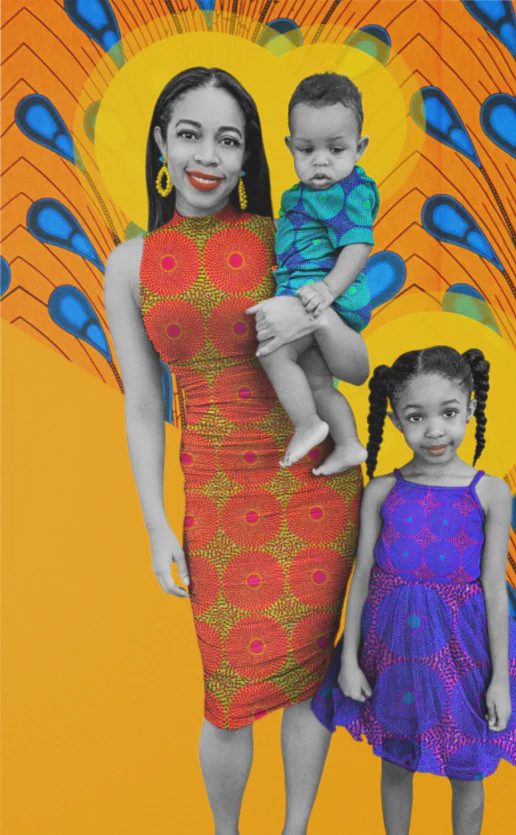
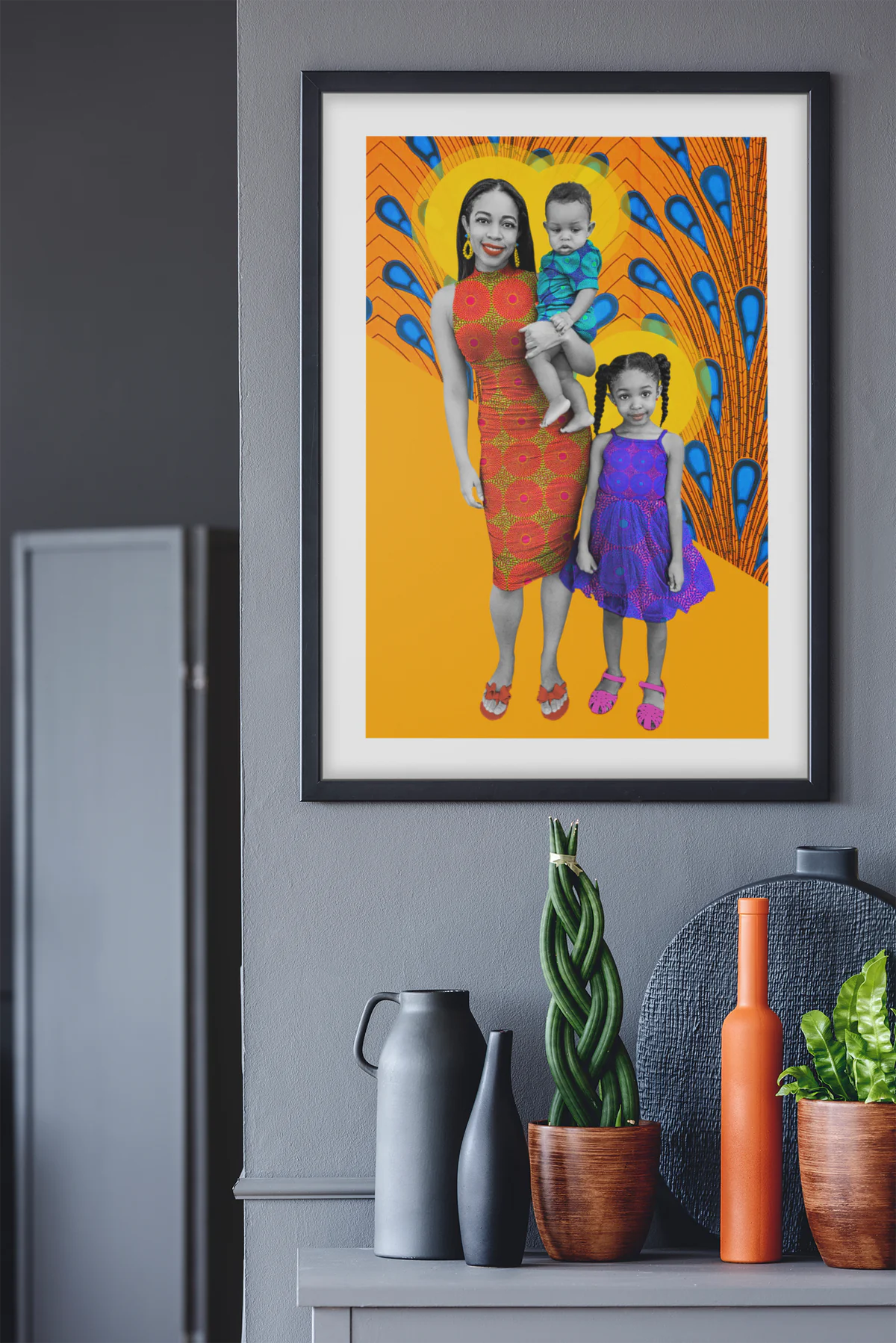
This particular artwork began with a real family photograph: a mother with her two children.
When I look at the original relationship between them, I don’t know what each child will eventually remember about this period of their lives.
I don’t know what the mother herself will remember.
And that uncertainty is important.
A commissioned portrait can be tempting to explain too completely.
This is their story.
This is what they mean to one another.
This is who they are.
But families are far too large for that.
A photograph gives us a moment, not a verdict.
So when I work into one, I am not trying to explain the family.
I am trying to give the moment more room.
Colour can do that.
Pattern can do that.
Scale can do that.
Something that may once have lived among thousands of photographs on a phone, or inside an album, becomes deliberate.
Look again.
These people mattered here.
This particular arrangement of them existed.
This mother was once this age.
These children once fitted beside her exactly like this.
There will never be another photograph taken of precisely these three versions of themselves.
That alone feels worthy of attention.
Perhaps this is what makes family photographs become more precious
When a photograph is new, we mostly recognise the people.
When it becomes old, we begin to recognise time.
That’s different.
At first:
That’s me.
That’s Mum.
That’s the children.
Later:
Look how young she was.
Look at the baby.
I’d forgotten that dress.
That was before we moved.
That was the year everything changed.
Eventually the background starts becoming as moving as the people.
The sofa nobody liked.
The wallpaper.
The old front door.
The chair that belonged to somebody else before it belonged to you.
Time enters the photograph slowly.
It wasn’t visible when the picture was taken.
But eventually, it becomes one of the main things we see.
Perhaps that is why portraits gain emotional value rather than lose it.
Most objects move in the opposite direction.
The new car becomes old.
The new phone becomes obsolete.
The fashionable thing dates.
But a photograph can begin as almost nothing — one image among hundreds — and quietly accumulate importance for forty years.
That is a strange kind of object.
It appreciates in meaning.
Mothers are particularly difficult to keep in the frame
There is another thought I can’t quite shake.
How many family histories contain thousands of things a mother saw and far fewer pictures of the woman who was doing the seeing?
The person behind the camera disappears easily.
The person arranging everyone else.
Remembering the sun cream.
Carrying the bag.
Finding the missing shoe.
Saying, “Stand over there, the light’s nicer.”
Later, the photographs faithfully prove that everybody had a childhood.
But who was creating the conditions in which so much of that childhood could happen?
This is not true of every family, and I don’t want to turn motherhood into sainthood. Mothers are human beings, not soft-focus symbols of endless sacrifice.
That is precisely the point.
They deserve to remain visible as people.
Not merely roles.
A woman does not stop having an interior life because somebody calls her Mum.
She is still becoming.
Still changing.
Still ridiculous in certain situations.
Still frightened by some things.
Still wanting things she may not always say aloud.
Still somebody’s child herself.
I love a family portrait that allows a mother to exist in the picture, not merely organise it.
And then there are the clothes
When I transformed this commission, the photograph moved into the visual language of Frequency of Love.
Pattern became abundant.
Colour became impossible to ignore.
The family were no longer simply wearing clothes.
Visually, they began occupying the picture.
That distinction matters to me.
Because family imagery can become very tasteful.
Soft.
Neutral.
Perfectly coordinated.
Beautiful in a way designed not to disturb the sofa.
There is nothing wrong with that.
But I am interested in something else.
I want to make the people difficult to overlook.
I want a child passing the artwork every day to see a mother who doesn’t recede politely into the background.
I want colour to give the relationship weight.
Not because loudness automatically equals importance.
But because there are forms of love we have been trained to consider ordinary simply because they happen every day.
Getting somebody dressed.
Packing the bag.
Remembering their favourite thing.
Knowing which cry means tired and which one means hurt.
Holding one child while checking where the other has disappeared to.
Ordinary does not mean small.
Sometimes ordinary means repeated so faithfully that nobody remembers it was an achievement.
One day, the children may look at this very differently
That is perhaps the strangest part of making commissioned family artwork.
The client who receives it today is not the only audience.
There are future viewers inside the picture.
The children themselves.
Today, perhaps the artwork belongs to their mother.
One day it may belong to them.
And they will not see what I see.
They will see knowledge.
They will know what happened afterwards.
They will know which characteristics stayed.
They will know who became taller than whom.
They will know the voice attached to the face.
They may know things about their mother that they could not possibly have understood when the photograph was taken.
And perhaps, for a second, they will meet a younger version of her.
Not Mum as a permanent institution.
A woman.
Standing there.
Beautifully herself.
At an age she once thought was simply the present.
We should probably photograph the adults more
Not only on birthdays.
Not only when everybody looks rested.
Not only after losing the weight or fixing the hair or finding something flattering.
The ordinary versions too.
The parent at the table.
The person cooking.
The person half listening.
The person laughing unattractively.
The person sitting on the floor surrounded by wrapping paper.
The person who complains they “hate having their picture taken”.
Take it anyway.
With permission, obviously.
Because one of the cruellest tricks of photographs is that we often dislike them when they are taken and treasure them once enough time has passed.
We look at an old version of ourselves and wonder what on earth we thought was wrong with her.
She was young.
She was lovely.
She was trying.
And we were standing there judging her arms.
Perhaps ageing gives us the tenderness towards our former selves that we could have used at the time.
There is a version of you becoming precious right now
That’s the thought I keep returning to.
Not someday.
Now.
The person you are tired of seeing in the mirror.
The house that still needs work.
The children at this awkward stage.
The ordinary routine.
The year that doesn’t yet seem particularly significant.
This is somebody’s past being made.
Possibly yours.
Possibly theirs.
One day, the photograph you nearly deleted because nobody looked quite right may be the only doorway left into an afternoon someone desperately wants to remember.
One day your child may look at your face and realise you were younger than they imagined a mother could ever have been.
One day they may notice your hand around them.
Your shoes.
Your smile.
The ridiculous colour you loved.
And they may remember something you have completely forgotten.
That is the extraordinary inequality of memory.
We do not get to decide which versions of ourselves other people keep.
Perhaps all we can do is leave them enough evidence.
Take the photograph.
Get in it.
Print some of them.
Put one on the wall.
Let yourself be visible.
Because your children are not only growing up in front of you.
You are growing older in front of them.
And somewhere inside their memory, a younger version of you is already becoming someone they will one day miss.
Make the photograph more than a photograph
A Frequency of Love family commission begins with an image that already matters and transforms it into something designed to stay visible — rich with colour, pattern, presence and personality.