
The first person you ever looked after may not have been real.
Perhaps she was plastic.
Perhaps he had one eye permanently half closed.
Perhaps there was stuffing where a nervous system ought to have been.
It didn’t matter.
You fed them.
Put them to bed.
Changed clothes that were not dirty.
Comforted them after catastrophes entirely of your own invention.
Carried them under one arm with the alarming casualness of someone who had apparently been parenting for years.
Children spend an extraordinary amount of time caring for things that do not need care.
And the longer I think about that, the less childish it seems.
A doll is a very strange object
It looks like a person but isn’t one.
It has a face but no thoughts.
It can be loved without ever loving you back.
It can be scolded.
Rescued.
Ignored for three weeks.
Rediscovered under the bed and welcomed into the family as if nothing happened.
Perhaps that is why dolls are so useful to children.
They remain completely available to imagination.
A child can give them a personality.
A history.
A medical emergency.
A sibling.
An appalling attitude.
A career.
A bedtime.
A complicated relationship with another stuffed animal.
The doll provides the body.
The child provides the world.
That feels important.
Because imagination is often discussed as though it is decorative.
A lovely extra.
Something children do before serious life begins.
But perhaps imagination is one of the first technologies we develop for approaching the future.
Before we live something, we often rehearse it.
Children practise lives before they understand them
They pour invisible tea.
Drive stationary cars.
Run shops containing no legal currency.
Cook meals nobody can eat.
Teach classrooms of deeply uncooperative teddy bears.
Become doctors without qualifications.
Parents without children.
Hairdressers with frightening confidence.
They create entire social structures before they can spell the word society.
And somewhere inside all that play, they are experimenting.
What happens if I am in charge?
What happens if somebody needs me?
What does comfort look like?
What does being cross feel like?
What happens if I say no?
What happens if I say sorry?
What happens if I am the grown-up?
They are not preparing for one fixed future.
They are testing possible selves.
I find that rather beautiful.
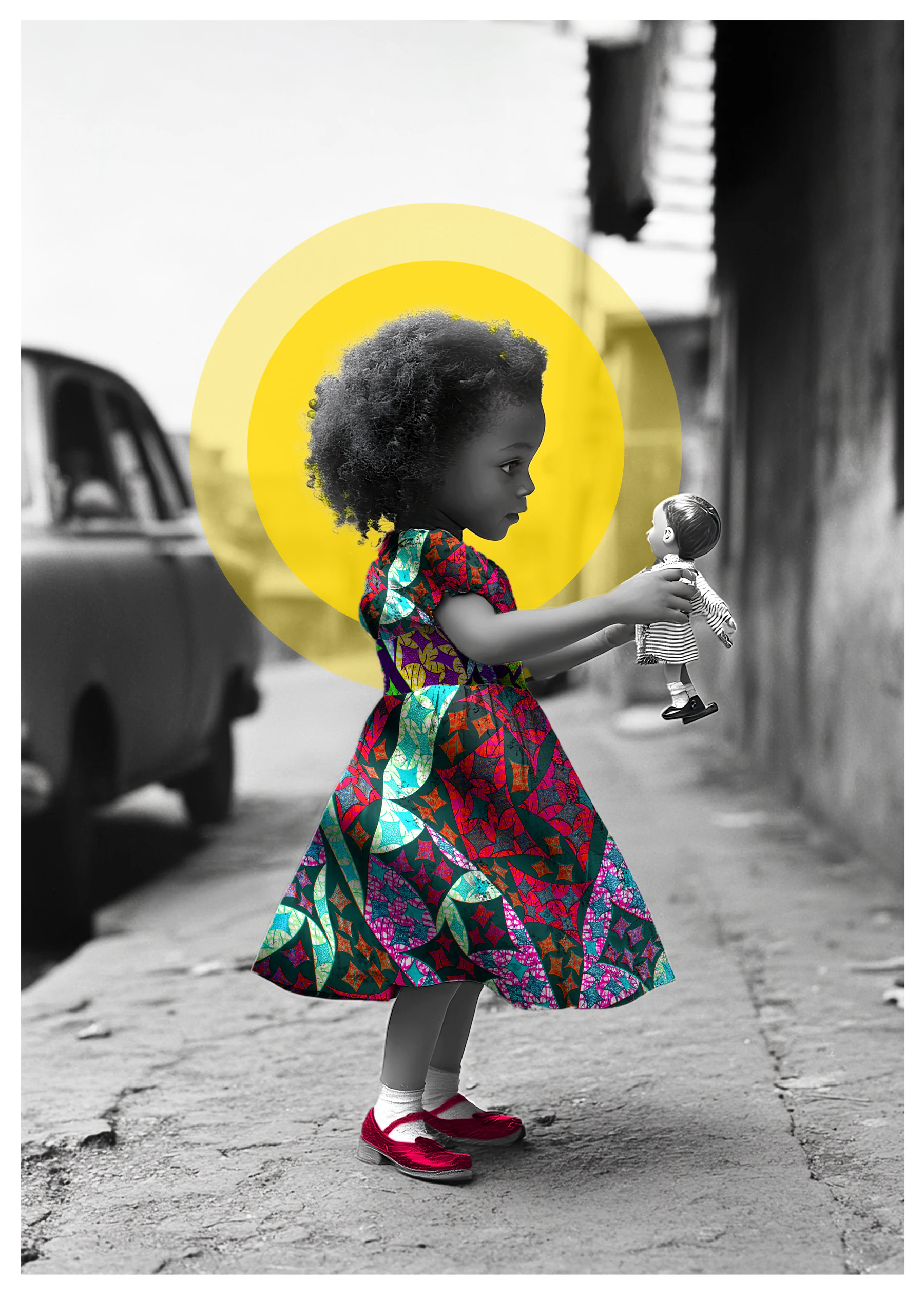
Then there is this little girl
She is holding a doll.
That is the obvious thing.
But the more I looked at the image, the less interested I became in the doll.
My eye kept returning to her.
She is magnificent.
Patterned dress.
Composed posture.
A kind of visual certainty.
The colour in the work gathers around her until she seems almost ceremonial.
The doll, by comparison, looks rather shabby.
And I love that.
Because there is an old visual hierarchy we are used to seeing reversed here.
The precious object is not necessarily the pale-faced doll being held.
The child is the splendour.
That shift feels deliciously important.
The doll does not need to resemble her for her to remain central
There is an obvious conversation available here about dolls and representation.
It matters who children see reflected in toys, books, television, advertising and art.
It matters which faces are treated as ordinary.
Which hair.
Which skin.
Which bodies.
Which families.
But this picture made me wonder whether resemblance is only one part of the question.
Because the girl does not disappear simply because the doll looks different from her.
Quite the opposite.
She dominates the image.
The doll is almost an accessory to her presence.
She is not looking at a better version of herself.
She is not visually subordinate to the thing in her arms.
She is not asking the doll for permission to be beautiful.
She already is.
That is a different kind of representation.
Not:
Here is a toy that looks like you, therefore you belong.
But:
You are already the centre of the picture.
There is something freeing in that, a freedom to remain fully present that runs through Before Somebody Tells You to Be Smaller too.
Sometimes representation is about hierarchy
Who is elevated?
Who is dressed with care?
Who gets colour?
Who gets detail?
Who is ornamental and who is important?
Who is allowed complexity?
We can put diverse faces into an image and still preserve old hierarchies.
Or we can change the hierarchy entirely.
That interests me much more.
In this artwork, the girl has the visual authority.
Her clothing carries the pattern.
Her figure holds the composition.
The doll may have the human-like form, but she has the presence.
I think that distinction matters.
Because dignity is not always created by likeness.
Sometimes it is created by scale.
Attention.
Beauty.
Position.
The right to be looked at carefully.
I wonder what children learn when they care for dolls
Not simply about motherhood or parenting.
That interpretation feels too narrow.
Perhaps a doll teaches something stranger.
The experience of projecting interiority onto another being.
The child knows, on some level, that the doll is not alive.
And yet she acts as if the doll might be tired.
Cold.
Sad.
Hungry.
Afraid of the dark.
She supplies feelings that are not physically there.
That is an extraordinary imaginative act.
And somewhere inside it is the beginning of empathy:
the ability to consider a state of mind other than your own.
Of course, children do not need dolls to learn empathy, and play does not unfold identically for every child.
But I find the mechanism fascinating.
A doll is empty enough for a child to practise imagining another person’s needs.
Maybe this is why children can become fiercely protective of toys adults regard as ridiculous.
The object is not the relationship.
The relationship is happening in imagination.
Adults should understand that better than anyone.
We do it constantly.
We are still rehearsing
Before an important conversation, we have it six times in our heads.
Before beginning something new, we imagine ourselves already doing it.
We furnish houses we do not own.
Compose speeches nobody has asked us to give.
Imagine resignations from jobs we have not yet left.
Picture meeting people we have never met.
Rehearse arguments while washing our hair.
Think about what we would say if somebody finally asked.
We call it planning when adults do it.
Or anxiety.
Or visualisation.
Or ambition.
Children call it playing.
Perhaps the border is thinner than we pretend.
We imagine our way towards things.
Sometimes the imagined version helps us recognise the real one when it arrives.
This is why I resist the idea that imagination is frivolous
The imaginary is not necessarily the opposite of the real.
Sometimes it is the workshop where reality is being prepared.
Before somebody makes a dress, they imagine it.
Before somebody builds a house, it exists as a thought.
Before a business opens, somebody has been living with it privately for months or years.
Before a child becomes an adult, they have tried adulthood on countless times through play.
Not accurately.
That is not the point.
Imagination does not need to predict the future.
It makes room for futures.
That is different.
And perhaps this is one reason children’s art and children’s spaces deserve more than generic encouragement.
I want images around children that make imagination feel legitimate.
Not merely cute.
Not something to grow out of.
A serious human faculty.
The environments that hold childhood can quietly make possible whole futures, an idea I explore from another angle in The Future Is Usually Photographed From Behind.
There is another thing I like about the shabby doll
It feels loved.
Or at least, visually, it allows me to imagine that possibility.
Not because I know anything about an actual child or an actual toy — this source image was AI-generated — but because worn objects often make us think about use.
The pristine toy in the box is desirable.
The battered toy is interesting.
One suggests possession.
The other suggests relationship.
A missing button.
Flattened fur.
A dress washed too many times.
A face rubbed smooth.
Children rarely preserve what they love in museum condition.
They use it.
Love is hard on objects.
That thought makes me smile.
The things we treasure most are sometimes the things we wear out.
Perhaps people are a little like that too.
The house that looks lived in.
The recipe card covered in fingerprints.
The book with a broken spine.
The handbag with receipts in every pocket.
The dining table carrying marks from years of people being there.
Perfection is impressive.
Wear tells a story.
The girl’s splendour makes the doll’s shabbiness even better
If both were immaculate, the picture would say something different.
Instead, there is tension.
One figure looks dressed for ceremony.
The other looks like it has survived nursery life.
And perhaps that is what makes the relationship charming.
The girl does not need the doll to be beautiful for the doll to be worthy of care.
That is another interesting lesson.
We say we value beauty, but affection has terrible standards.
We love crooked things.
Old things.
Embarrassing things.
Objects that objectively should have been thrown away years ago.
The chipped mug.
The childhood blanket.
The teddy bear whose species is no longer identifiable.
Love is remarkably uninterested in market value.
This may be one of its better qualities.
What we care for begins to shape us
There is a very adult assumption that identity is something internal.
Who am I?
What do I believe?
What do I want?
But perhaps we also become ourselves through what we repeatedly attend to.
The garden.
The child.
The work.
The friendship.
The animal.
The house.
The idea.
The elderly parent.
The community.
The thing nobody else understands why we care about so much.
Attention has consequences.
Care creates habits.
Patience.
Responsibility.
Frustration.
Tenderness.
Sometimes resentment.
Sometimes astonishing devotion.
We are changed by the things we decide are worth looking after.
That may begin much earlier than we realise.
A child holding a doll is not necessarily practising one future role.
Perhaps she is discovering that her attention has power.
She can create comfort.
Order.
Story.
Meaning.
That feels larger.
And what if the doll is not really the vulnerable one?
This is where the image turns around for me.
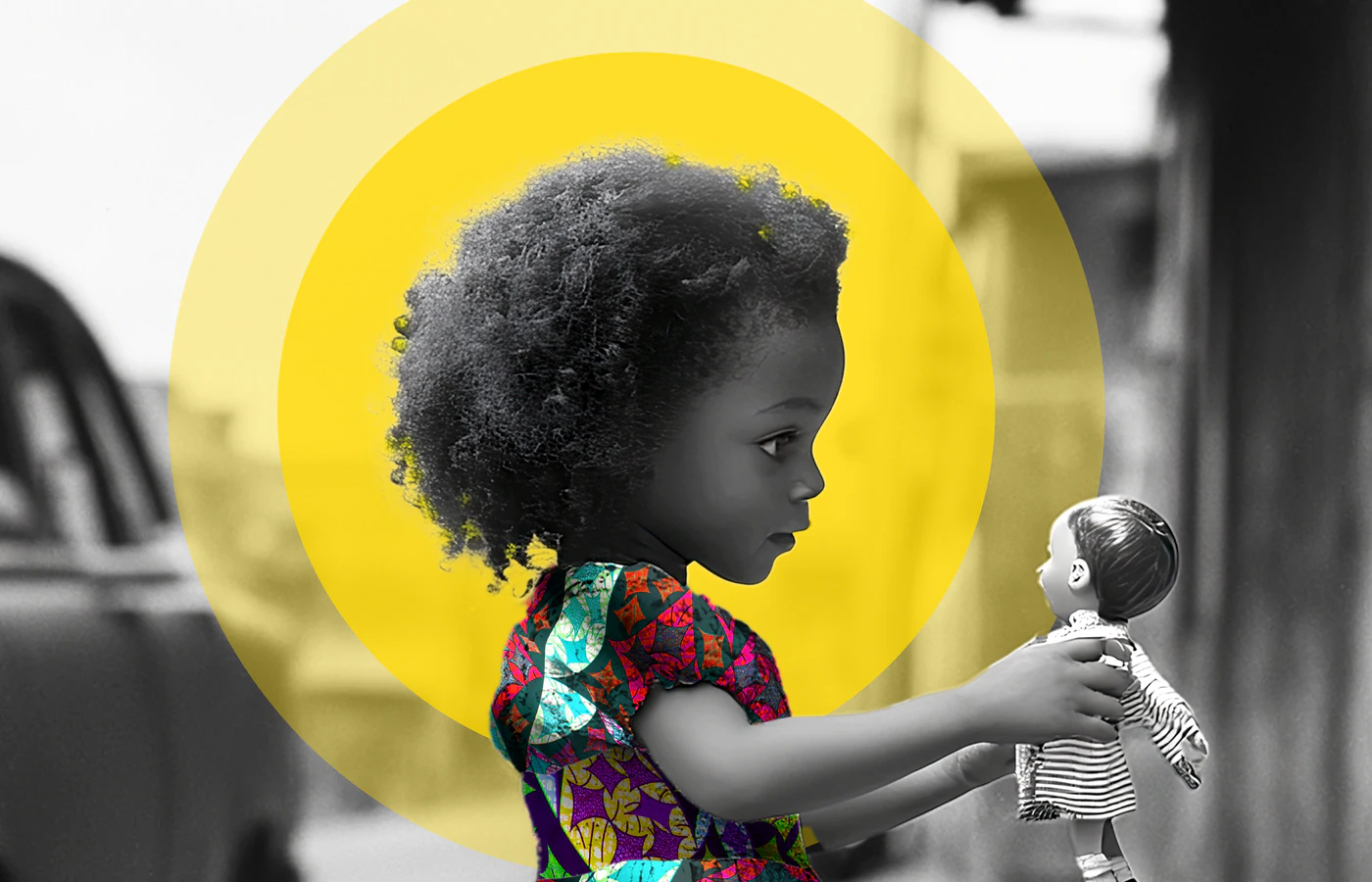
At first glance, the little girl is holding the doll.
So we assume she is the carer and the doll is the thing being cared for.
But the doll may also be serving her.
It gives her somewhere to put imagination.
Somewhere to put tenderness.
Somewhere to practise authority.
Somewhere to rehearse language.
Somewhere to create a world in which she controls the rules.
Perhaps play objects are not passive after all.
They give children a space in which they can become visible to themselves.
That is a beautiful exchange.
The child animates the doll.
The doll gives the child somewhere to animate herself.
Maybe that is what art does too
This occurred to me only after sitting with the picture for a while.
We often talk about what artwork gives us.
Beauty.
Colour.
Atmosphere.
Meaning.
But perhaps artwork also gives us somewhere to put ourselves.
You bring your memory to it.
Your associations.
Your politics.
Your childhood.
Your sense of humour.
Your discomfort.
Your tenderness.
The artwork remains physically unchanged while completely different people encounter different things inside it.
In that sense, perhaps looking at art is not entirely unlike play.
The object provides the structure.
The viewer supplies part of the world.
That may be why I resist explaining every artwork completely.
Explanation can close the door too soon.
I would rather leave some room.
The girl does not need us to rescue her from the picture
That feels important.
The temptation with images of Black childhood can be to load them immediately with history.
Representation.
Racism.
Exclusion.
Struggle.
All real and necessary subjects.
But a Black child should also be allowed to exist in an artwork without carrying the entire explanatory weight of race on her shoulders.
She can be beautiful.
Funny.
Regal.
Self-possessed.
Imaginary.
Ordinary.
Strange.
Tender.
She can hold a shabby white doll and allow the picture to be about care, play, hierarchy, imagination and the peculiar emotional life of objects.
That possibility itself has value.
Sometimes liberation is not having to make every image defend your existence.
Sometimes you simply get to be the most magnificent person in the room.
Perhaps childhood gives us one of our first lessons in creation
A child takes something incomplete and supplies what is missing.
The cardboard box becomes the shop.
The towel becomes the cape.
The stick becomes the wand.
The doll becomes a person.
It is an extraordinary refusal to accept the limits of the object.
And perhaps artists never entirely stop doing that.
We look at what is there and ask:
What else could this be?
That is certainly part of my artistic process.
The original image gives me one visual world.
Then colour interrupts it.
Pattern enters.
Scale changes.
A figure becomes more commanding.
Something ordinary becomes slightly impossible.
I am not trying to disguise where the image began.
I am interested in where imagination can take it through my wider body of Work.
Maybe the little girl and I are doing versions of the same thing.
She animates the doll.
I animate the picture.
We both add what wasn’t there before.
Before we build a life, perhaps we play with the possibility of it
I keep returning to that thought.
We are always becoming before we arrive.
Imagining before doing.
Trying on.
Rehearsing.
Changing the rules.
Creating little versions of possible worlds and seeing how they feel.
Some of those worlds disappear.
Some become real.
Most change completely along the way.
That is fine.
The value of imagination was never that it could predict our future perfectly.
Its gift is that it makes the future feel inhabitable before we know exactly what it contains.
And perhaps that is what I ultimately see when I look at this girl.
Not a child waiting to grow up.
Not a little mother.
Not a lesson in representation wrapped neatly around a doll.
A creator.
Somebody already learning that the world in front of her does not have to remain exactly as she found it.
Give her an object.
She will give it a life.
Give her a room.
She may turn it into a kingdom.
Give her a future.
And perhaps she will imagine something we were not clever enough to predict.
Make room for imagination
This Original Work belongs to a collection where bold colour, pattern and unexpected visual relationships invite us to see familiar things differently.